.svg)
When you're fit and healthy, exercise is a choice.
And when you don't feel like it, there's always tomorrow.
But when you're diagnosed with a disease that suddenly shatters your vision of tomorrow into a million pieces, everything changes.
How does exercise feel when your future is hanging by a thread? Or when your body is tired, drained, sore and depleted? Would you have what it takes to keep exercising when your health reaches rock bottom?
In this evocative piece, our HR Manager, Iwona Izbinska-Sosnowska, shares her story with breast cancer from 2019 and how early morning dog walks saved her life.
(All words by Iwona)
In May 2019, cancer entered my life without asking permission. I was invaded by an angry 3rd stage graded tiger which was called breast cancer. That tiger had 3 friends: big ones. They were called tumours. Big 5 cm ones inhabited my breast. Growing so fast that within a week, they grew into 7 cm. Mastectomy was booked within 8 days.
I remember going to the hospital by bus. Early in the morning at 07.00. For the scheduled operation, after which I would be awakened without a breast.
My husband was then in hospital fighting with his gallbladder infection, and a bag attached to his belly… for weeks staying in hospital.
My daughter was little. I was alone walking the hospital corridors for an “amputation” to be executed on my body..
There were two years of harsh chemotherapy after that and another operation, followed by radiotherapy in Southampton. The scary terminology that haunted me since then. And when I thought I had finally reached the other side of treatment, there was more. I found myself back in the oncology unit, returning for another year and a half of Herceptin through IV infusions.
The hospital became a place I knew too well. Two operations, chemo, radiation and again back to IV infusions with red liquid inserted into my veins called chemo treatment.
Oncology departments, treatment rooms, needles, drips, waiting rooms, blood tests. The language of cancer became the language of my everyday life.
And then COVID arrived in February 2020.
It brought a different kind of terror.
Hospitals were overwhelmed. Resources were limited. Doctors were facing impossible decisions about who could receive treatment and who might have to wait. I remember the fear of knowing that somewhere, behind the doors of the hospital, decisions were being made about people like me.
I was 51.
And I remember thinking:
Am I young enough to be treated?
Or had I somehow crossed an invisible line where my age meant someone else might be considered a better chance?
I remember waiting for the telephone to ring.
Waiting for the oncology department. Waiting to find out whether I would be called in. Waiting to find out whether I was in the "younger" group or the "older" group.
Waiting to find out whether I was young enough to live.
People didn’t talk about it then and they don’t talk now. This is a shameless history from the COVID era.
There are fears that scream.
And there are fears that sit quietly beside you while you wait for the telephone.
That one sat beside me every day.
Meanwhile, my body was being pushed beyond anything I had ever imagined.
The chemotherapy left me shaking; sometimes my whole body trembling uncontrollably.
My fingernails began to fall apart. Some literally came away. I had to put plasters over my fingers. I was conscious of how frightening I must have looked. I even worried that someone working in a shop might see my hands and feel sick.
My nails turned black. They looked like something from a Halloween display.
But it wasn't Halloween.
It wasn't a costume.
It was my body showing the world what was happening inside it.
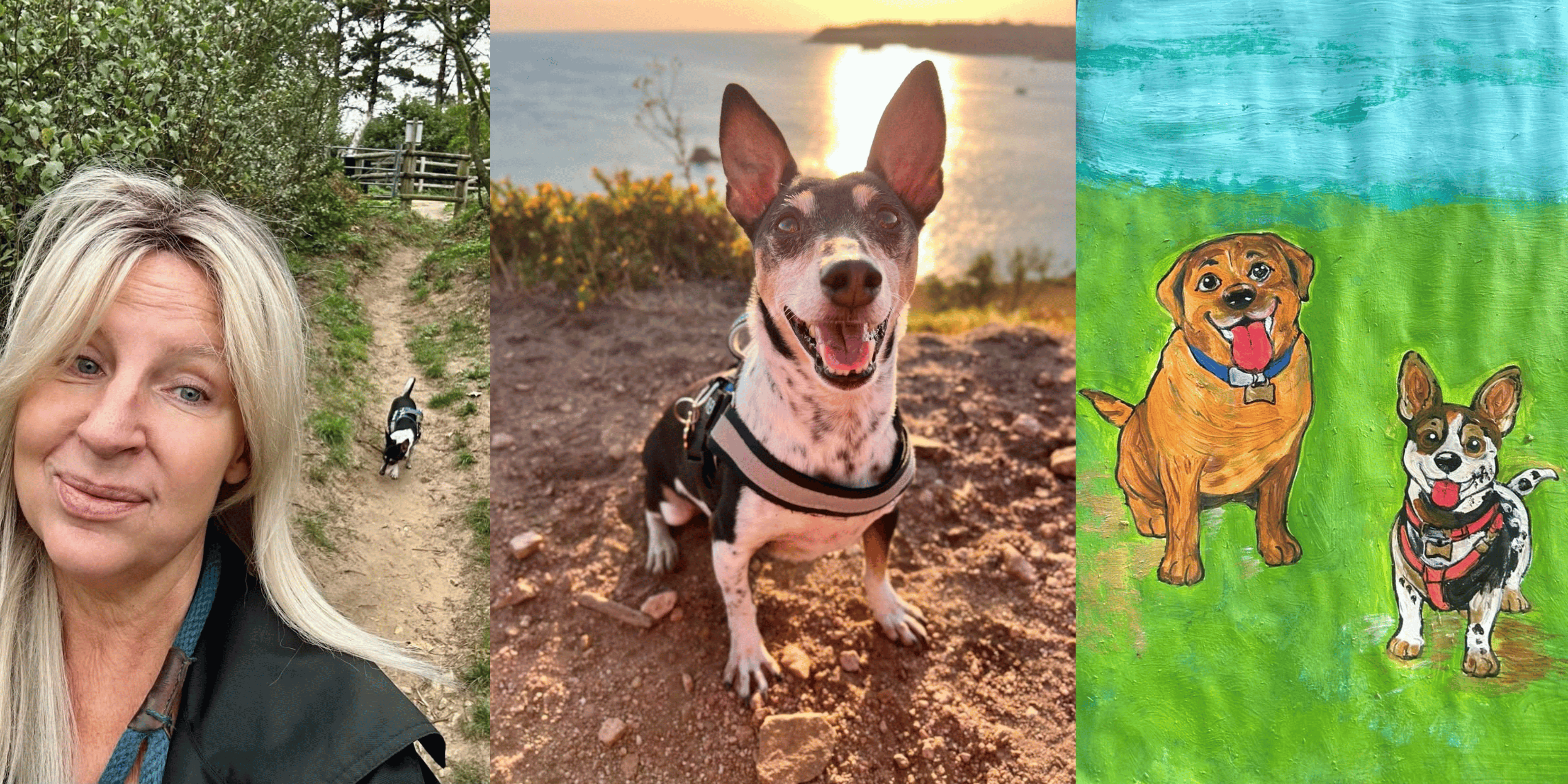
And then there was Luis. My little dog.
I don't think I understood at the time what he was doing for me.
I only knew that every morning, he needed to go out.
Six o'clock in the morning. That was the time.
And so, somehow, I had to get out of bed.
My body was exhausted. Vulnerable. Sometimes still shaking. There were mornings when I would cry because I simply didn't want to move. Vomiting from chemotherapy didn’t let me raise my head.
But Luis didn't know any of that.
He just knew that it was morning. He needed his walk. And he needed me.
So I got up.
I dragged my exhausted body outside and walked with him through the dunes and along the paths.
I didn't walk because I was strong.I walked because I had to.
There is a difference. But that difference probably saved me.
Nathalie Le Mottée, the Co-Founder of Healthhaus who interviewed me at Healthhaus on Boxing Day in 2020, said to me at that first meeting that maybe exercise like forced (then) dog walking saved my life. She was right. Six years later, I still recall that sentence…
Sometimes people talk about exercise during cancer treatment as though it is a matter of discipline. As though you simply have to decide to be active.
They don't always see reality.
They don't see the person standing beside the bed, wondering how on earth they are going to put their feet on the floor.
They don't see the tears.
They don't see the shaking. Your belly moves inside out like you have someone living inside you; like an alien. This is chemo dancing inside your inner organs killing the bad cancer and the good stuff - your organs, kidneys, liver, lungs…
They don't see how enormous a few hundred metres can feel when your body has been through chemotherapy.
But Luis didn't ask me to be strong. He just asked me to come with him.
And so I did. Day after day.
Sometimes I would walk and cry. Sometimes I would wonder how much longer I could continue. Sometimes I just wanted to go back to bed.
And then Luis, my beloved little dog, would lie down beside me.
His little warm body next to mine.
My body was cold after chemotherapy, and somehow he seemed to know. He would press himself against me, trying to warm me. He couldn't understand cancer. He couldn't understand chemotherapy or oncology or the fear of waiting for the telephone. But he understood the bandages around my chest. The scars.
He couldn't understand that I was terrified. That I wanted to live. That I did not want to die the following month.
I stopped buying clothes then in chemo because I didn’t want to think that I would never wear them. Maybe to my coffin... If I didn’t succeed.
But perhaps he understood something much simpler. He understood that I needed him.
And he stayed.
Years later, when I look back, I realise something that I couldn't see while I was living through it.
.png)
Luis was one of the reasons I got out of bed. My dog walking routine saved me.
Not once. Every day.
He made me move when I probably wouldn't have moved otherwise.
He made me walk when my body told me to stay still.
He gave me a routine when cancer had taken almost every ordinary routine away from me.
And perhaps most importantly, he gave me a reason.
I had compassion for him. I couldn't leave him without his walk. I couldn't tell him that I was too sick today. So I got up. I walked. And in doing that, perhaps I was also helping myself.
I don't know what would have happened without him. I genuinely don't.
Maybe I would have stayed in bed more. Maybe I would have stopped exercising altogether. Maybe I would have become even more isolated inside that frightening world of cancer and treatment.
I will never know.
But I know what happened with him, and with me. He got me out of bed. He got me outside. He got me walking.
And sometimes, when life has become unimaginably difficult, that is enough.
We often imagine surviving cancer as something dramatic, and I hate when people say: it’s a journey. It’s not. The journey needs to be fun, exciting and interesting. Nothing of cancer was exactly that.
It was an enormous endless battle, and it wasn’t a moment of triumph, and in fact I was searching and waiting for a moment of triumph. Every day is that, when you are a survivor.
But the survivor was much smaller. I didn’t run a marathon as many cancer patients do. My survival was every day walking further and further, getting stronger until one winter day when I put on ice skating boots and for the first time for years, I once again stood on ice and ice skated. After chemo!
And I honestly don't know whether I would be here without exercising with my little dog every day. Exercising myself by walking him, by getting up at 6.00.
But I do know that this is how my survival begins. From little steps that dragged my exhausted body from bed. Because it’s worth it.
********
October is Breast Cancer Awareness month. Find out more about ABC Jersey